 (713) 965-7200
 The Essential Guide to Business Continuity and Disaster Recovery for Law Firms


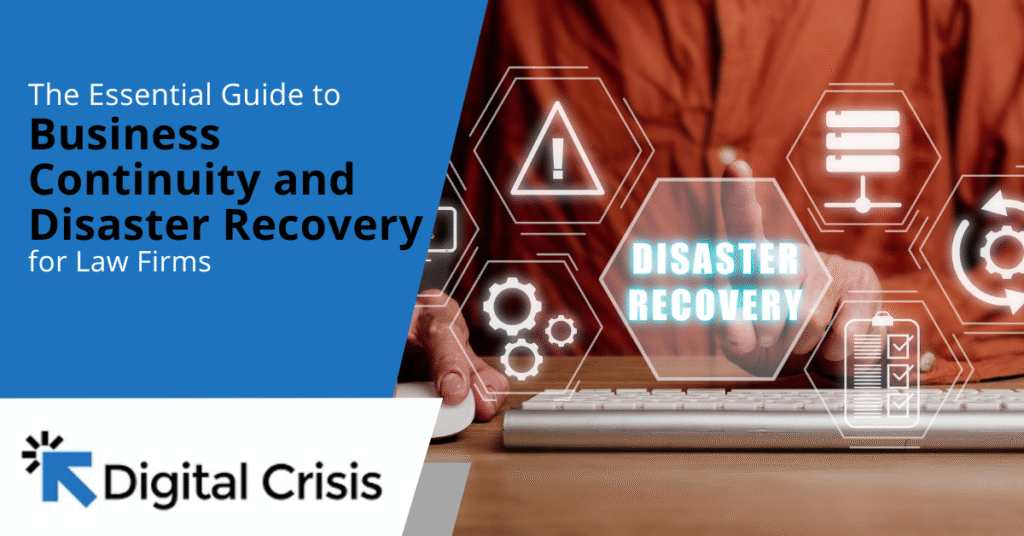
When a critical case deadline collides with an outage, there’s no grace period. Clients still expect updates, courts still expect filings, and partners still expect billable work to move. That’s why law firms need a plan to keep practicing through disruption.
According to IBM’s Cost of a Data Breach Report, the average global cost of a data breach is $4.4 million, driven by business disruption and recovery costs. The American Bar Association reports that about 29% of firms have experienced a security incident. These numbers should make any managing partner pause.
Backups play a role, but they’re only one layer. A resilient firm needs the right mix of people, processes, and technology so it can resume operations quickly without breaking confidentiality or ethics rules.
Not sure where to start? Begin with what works and build from there. Strong data backup and recovery services are only one piece of the puzzle. Equally important are governance, testing, and communication. By pulling these threads together in a clear business continuity plan, you ensure that when the pressure is on, everyone knows their role.
Why Law Firms Can’t Afford Downtime
Before tools, get clarity. What absolutely must keep running if your office loses access to its case management system at 9:00 a.m.? Who informs clients? Who files the motion? How do you get into email if SSO is down?
Law firms remain high-value targets because client data, deadlines, and reputation are tightly linked. IBM’s 2025 research shows disruption costs are a major slice of breach impact, as lost productivity, emergency forensics, and delayed work product all stack up fast. Meanwhile, ABA survey data confirms the profession’s exposure: Nearly one in three firms has felt the sting of a security incident.
So, what exactly are we building?
- Business Continuity (BC) keeps essential operations moving during and after a disruption.
- Disaster Recovery (DR) focuses on restoring affected IT systems and data (servers, apps, networks).
- Incident Response (IR) covers detection, containment, eradication, and post-incident lessons.
NIST SP 800-34 remains a practical reference for planning roles and definitions across BC/DR/IR. Set two guardrails early: RTO (how fast you must restore a system) and RPO (how much data you can afford to lose, measured in time). If you can’t name RTO/RPO for email, DMS, and phones, testing will be guesswork.
Finally, business continuity isn’t just about technology. It’s about bandwidth. With the right managed IT services, you get 24×7 monitoring, runbooks, and surge support when your internal team is already juggling client work.
How to Build a Resilient BC/DR Strategy for Legal Practices
You can’t purchase resilience outright. You must build it. The steps below offer a blueprint, but the details should be tailored to your firm’s size, the kind of work you do, and the risks you face.
1. Risks and Impacts With a Business Impact Analysis (BIA)
Begin with the essentials: intake, e-filing, document access, billing, timekeeping, and client communication. Then look closer. What systems do they rely on: identity management, VPN, DNS, or MFA? And what obligations hinge on them, like meeting filing deadlines or honoring client contracts?
Then, assign RTO and RPO per system and confirm who signs off. NIST SP 800-34 offers a clear way to document this so stakeholders see the tradeoffs in plain language.
Ask yourself: If our DMS is unavailable for six hours, how do we file, collaborate, and maintain holds? If the answer is “we’ll figure it out,” you have work to do.
2. Address Ethical and Compliance Obligations
Continuity decisions live inside your ethical duties, especially confidentiality and communication.
- ABA Model Rule 1.6(c): Take “reasonable efforts” to prevent unauthorized access or disclosure.
- ABA Formal Opinion 477R: Evaluate sensitivity and apply appropriate safeguards for electronic communications (which may include encryption).
- ABA Formal Opinion 483: If a cyber incident occurs, firms have duties to investigate, remediate, and, where appropriate, notify clients.
Build these expectations into your plans and training. Otherwise, the first time a partner voices “Do we have to tell the client?” will be in the middle of a crisis.
3. Strengthen the Technical Foundation
Think about your systems in layers so no single failure can take everything down.
- Backups with immutability: Move beyond simple copies to keep at least one immutable or air-gapped version. Test restores quarterly to prove you can meet your RTO/RPO under load, not just restore “a few files.”
- Failover for core apps: Set up backup systems for the essentials, such as email, document management, billing, and phones, so you’re not scrambling if the primary ones go down. Write out the steps for making the switch and note any special requirements, like DNS updates or break-glass access for admins.
- Access and identity continuity: If SSO or MFA fails, how do privileged users authenticate to perform recovery? Maintain sealed break-glass credentials with dual-control access.
- Network and connectivity: Plan for secondary ISPs, mobile hotspots for key staff, and VPN alternatives if your primary gateway is offline.
4. Prepare People and Processes
Technology won’t brief clients, but people will. Build a crisis communications plan that covers:
- Internal notifications: A simple decision tree for who alerts whom.
- Client messaging: Pre-drafted updates that follow ABA 483 requirements.
- Media posture: Clear coordination with counsel and your cyber insurer.
Run tabletop exercises at least annually and after major changes. Keep them short and realistic; even 90 minutes is plenty to expose gaps. Capture lessons learned and fold them back into your runbooks and training.
5. Manage Vendor and Insurance Dependencies
Your continuity is only as strong as your vendors’. For DMS, eDiscovery, email, and practice-management platforms, negotiate:
- Uptime and RTO/RPO commitments.
- Breach-notice windows and cooperation clauses.
- Export paths and data-portability options if you must move fast.
Cyber insurers increasingly expect proof of controls such as MFA, endpoint detection and response, and immutable backups, and they may ask for test evidence at renewal. Treat this documentation as part of your program, not a scramble in Q4.
Put Resilience Into Practice Today
Continuity isn’t perfection. It’s preparedness. You’re not promising zero incidents. You’re promising your clients that your firm can absorb a hit and keep serving them with integrity.
At Digital Crisis, we help law firms design and test BC/DR programs that align with ethics rules, hit practical RTO/RPO targets, and keep matters moving, even when something breaks. From BIA workshops and runbook design to restore testing and secure failover, we build resilience you can prove. Contact us to start your plan and protect the trust you’ve earned.